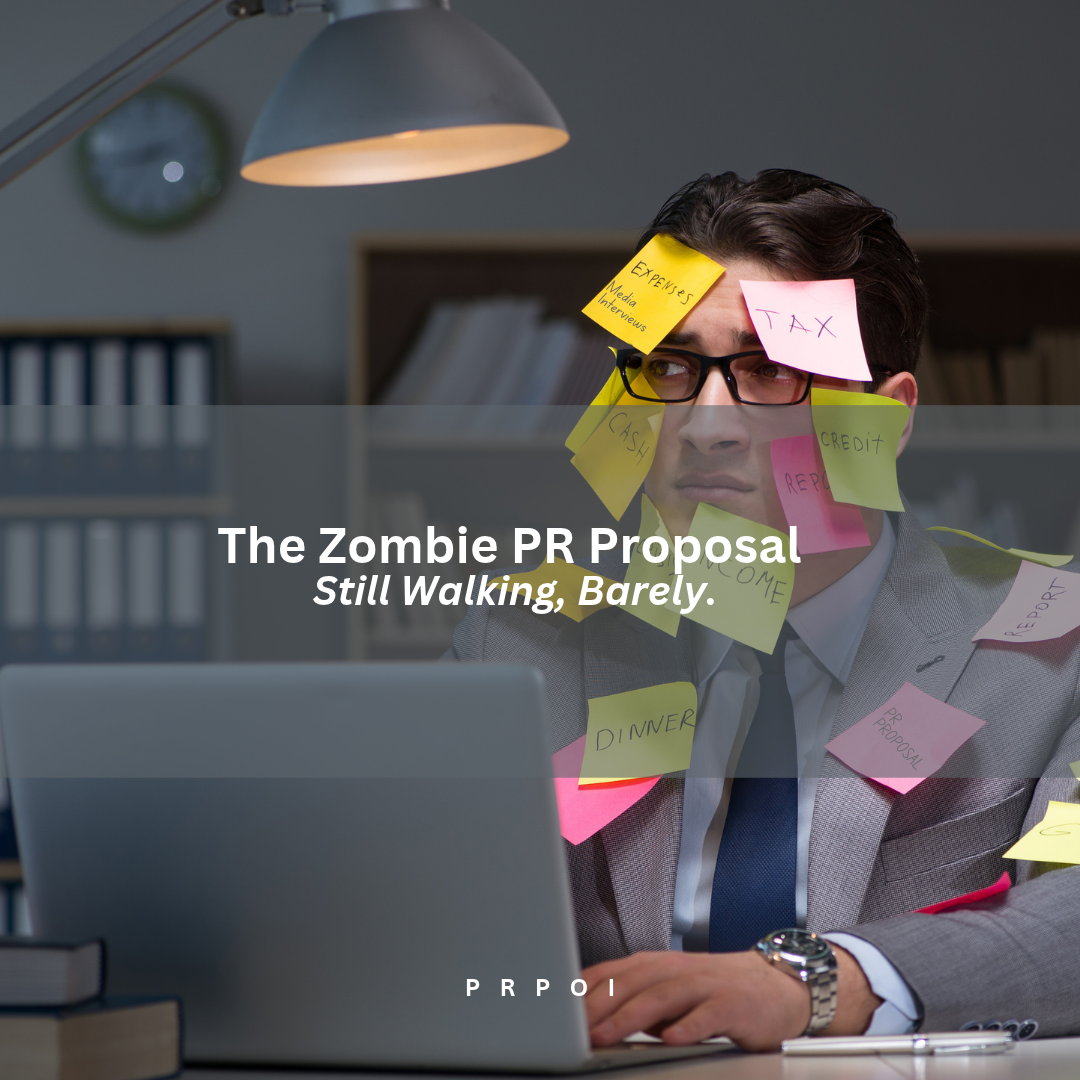
Why the PR Proposal Needs an Overhaul
Pull out a PR proposal from five years ago and compare it with one being presented today. Chances are, a large part of it will look surprisingly familiar: media coverage, press releases, journalist interactions, interviews, story opportunities and monthly reports.
Coverage. Coverage. Coverage.
Then twelve months later, when the contract is up for renewal, everyone goes back to that same proposal. How many releases were promised? How many were delivered? How many journalist interactions happened? How much coverage came in? Which publications covered us?
We spend the year managing communications and reputation, and then assess the relationship against a checklist of activities agreed twelve months earlier.
PR has moved on. Too many proposals have not.
The mandate today is much wider. Corporate communications teams are dealing with CEO positioning, thought leadership, social conversations, employee communication, creators, podcasts, analysts, digital reputation, crisis preparedness, search visibility and now AI-generated answers. Yet the commercial relationship often continues to be anchored to one dominant currency: how much coverage can the agency deliver?
There is nothing wrong with coverage. Earned media remains one of PR’s strongest credibility engines. But coverage cannot continue to be both the strategy and the report card.
Coverage is an output. Reputation is the outcome.
PRCAI’s SPRINT 2024-25 research reflects how significant this shift already is. Ninety per cent of corporate communicators surveyed said PR value is moving towards business impact over media exposure, while the same proportion saw the need for a broader paid, earned and owned approach.
The mandate has expanded. The measurement often has not.
And that is where another problem begins.
A proposal promises 20 stories. Twenty is easy to count. It promises ten journalist interactions. Also easy to count. But did the company become part of the conversations that actually mattered? Did its leadership become more credible? Did the narrative become stronger? Did the right stakeholders notice? Those questions are harder, so at renewal time we often fall back on what fits neatly into Excel.
International research points to the same gap. Muck Rack’s measurement research has found that stories placed remain one of the most widely tracked PR metrics, while practitioners continue to struggle with connecting communications measurement to business goals and stakeholder expectations.
The problem is not lack of activity. The problem is mistaking activity for impact.
AI makes this conversation even more relevant.
Research, monitoring, summarisation, first drafts and several routine communications tasks are already becoming faster through technology. If technology can increasingly accelerate the basic output, agency value cannot continue to sit primarily in producing more material.
It has to move higher up the chain. The real value is in judgement: knowing which conversation matters, understanding context, challenging a weak narrative, reading stakeholders, anticipating how an issue may travel, and advising leadership when to speak and when staying silent may be smarter.
AI can accelerate execution. It cannot automatically provide judgement.
Yet many proposals still sell the machinery of PR more clearly than the thinking behind it. There is also a bigger reputation reality to consider. A company can be well covered in business media, criticised in an online community, barely visible in search and poorly represented in an AI-generated answer, all at the same time.
Reputation no longer lives only in the media. It is being shaped across journalism, search, leadership voices, employees, creators, communities, analysts, social platforms and AI systems. So when a mandate comes up for renewal, the discussion obviously has to include what was promised and what was delivered. Accountability matters.
But it cannot stop there.
At renewal, the question cannot only be: Did you deliver? It has to be: Did it matter?
Did communications strengthen credibility with the stakeholders that mattered? Did leadership gain meaningful visibility? Did the organisation’s narrative become clearer? Did communications help protect trust when pressure emerged?
And where communications was linked to broader organisational priorities, there is another question worth asking:
Did any of it create measurable business impact?
That does not mean forcing every PR activity into a sales number. Reputation rarely works that neatly. But communications should still be able to demonstrate contribution to market credibility, stakeholder confidence, customer trust, talent attraction, leadership positioning or entry into a new market.
That is a much more useful conversation than counting clips at the end of the year.
A full clipping report can still hide an empty impact story.
Perhaps that is where the overhaul really begins.
Stop treating the PR proposal like a coverage contract. Make it an agreement on what communications is expected to change.
Senior Marketing & Communications Strategist – Datamatics Business Solutions Ltd.

You May Also Like

Influencing the Influencer – Advocacy in PR

International Women’s Day: Another marketing gimmick or what women want?